Seals at Horsey and Blakeney: when to go, and how to watch them
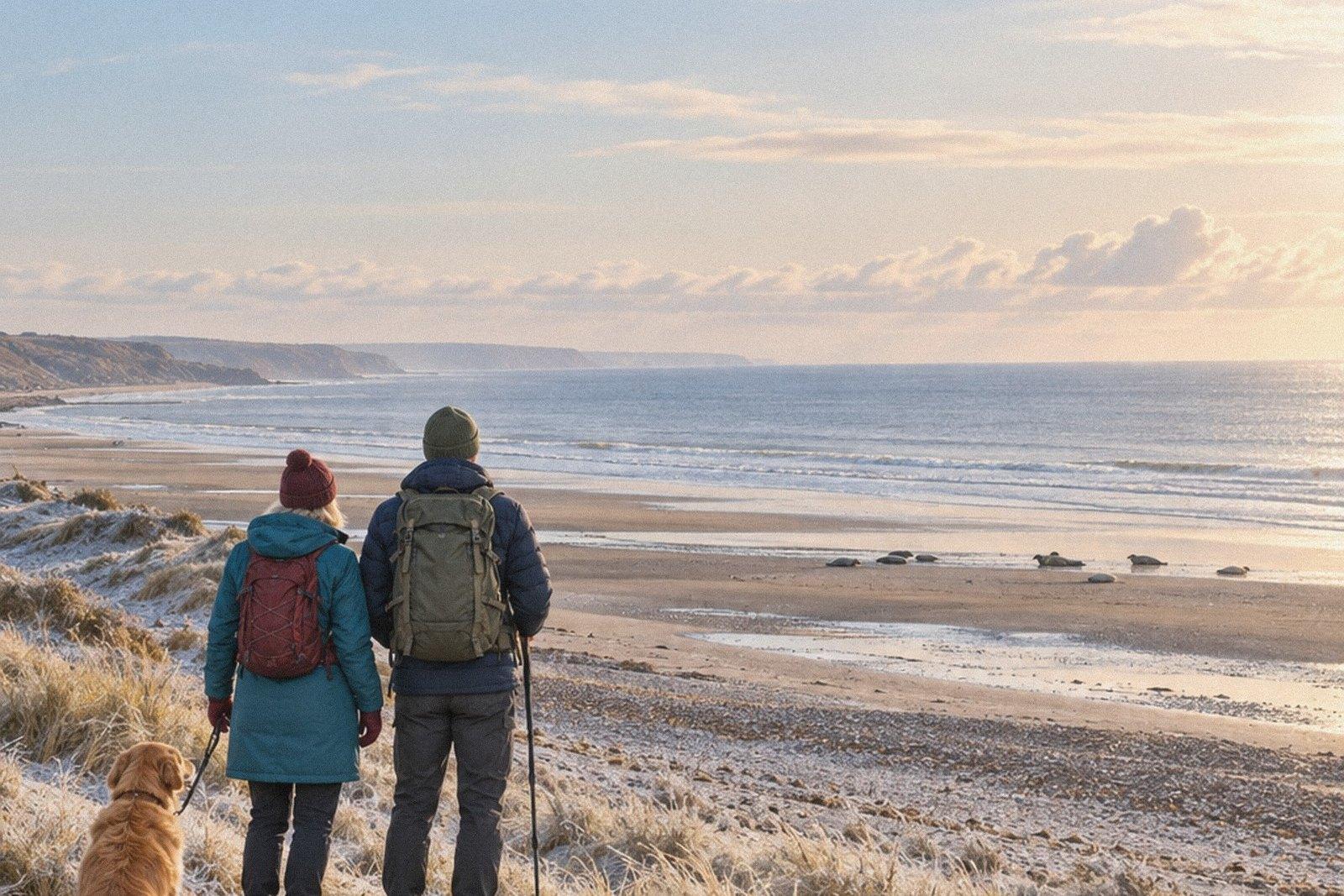
Go between mid-November and mid-December. Grey seal pups are born at Horsey and Winterton from the beginning of November to the end of January, with most births from mid-November to mid-December, the Friends of Horsey Seals say. At Blakeney Point around 9,000 pups are born each year, and you see them from a boat out of Morston Quay, not on foot.
| Pupping season, Horsey | Beginning of November to end of January |
|---|---|
| Most births, Horsey | Mid-November to mid-December |
| Pups a year, Blakeney Point | Around 9,000 (National Trust) |
| How close | No nearer than 100 metres |
| Horsey beach | Closed to walkers in the pupping season: view from the dunes |
| Blakeney Point | Boat from Morston Quay; no dogs on the Point 1 November to mid-January |
| Checked | 6 November 2026 |
When are the seal pups born in Norfolk?
Grey seals come ashore on the east Norfolk beaches in late October and early November to give birth and mate. At Horsey and Winterton the pupping season starts at the beginning of November and draws to a close at the end of January, the Friends of Horsey Seals say, and the greatest number of births fall between mid-November and mid-December. That is also when the most visitors come, and it gets especially busy over the Christmas school holidays.
Blakeney Point, on the north coast, runs to a similar clock. The National Trust, which looks after the Point, says it is home to England's largest grey seal colony, with around 9,000 pups born between the end of October and mid-January each year.
So the short answer for a van trip is a midweek visit in the second half of November or the first half of December. You get the most pups and, outside the school holidays, the fewest people. If the only time you can go is Christmas week, go anyway, but arrive early.
What will I actually see?
A beach that looks, at first, like it is scattered with driftwood. Then the driftwood moves. The adult cows lie along the tideline, heavy and grey, and the pups lie beside them in a white coat the Friends call a lanugo. They are born at around 13 kg and reach about 45 kg in three weeks, fed on milk the Friends say is up to 50 to 60% fat. By the end of that time they look less like a pup and more like a fat white cushion.
A cow suckles her pup for 17 to 23 days, the Friends say, and then leaves. The pup stays on the beach alone for around another three weeks, moults its white coat, grows a grey waterproof one and lives off its fat until it is ready to go to sea and teach itself to fish. So a lone pup on the sand is usually not an abandoned one. The National Trust says the same: pups are left to fend for themselves once they are weaned, and in most cases a pup on its own is perfectly normal.
The bulls are the ones to watch. They are huge and territorial, the Friends warn, and over a short distance they can move faster than you can run, especially downhill. They sometimes follow a cow into the dunes, where a hollow can hide a seal until you are almost on top of it.
How do I see the seals at Horsey?
From the top of the dunes, not from the beach. As the beach fills with pregnant seals in late October or early November, the Friends of Horsey Seals put a voluntary beach closure in place. You can still reach two viewing areas on the dunes from Horsey Gap car park. The paths are roped off and clearly marked, and the Friends move them now and again so the worn ground can recover.
The Friends' wardens wear yellow hi-vis vests. They are on duty at weekends, every day in term time and right through the Christmas school holidays, and they will tell you which viewing point is best that day. Some viewing points are half an hour's walk from the car park, the Friends say, so allow time to get there and back before your parking runs out.
The coastal track to the viewing areas has an uneven surface and often large puddles, which the Friends say can make it hard going for anyone with limited mobility. Wear boots, not trainers. The wind off the North Sea finds every gap in a coat: the Friends' own advice is warm, waterproof clothing, because it can be bitterly cold on the east coast.
Where do I park a motorhome or campervan for Horsey?
Not at Horsey Gap. The car park there belongs to the Horsey Estate, and the Friends' visitor page says overnight parking, motorhomes, camping and barbecues are not permitted. It also has no public toilets.
The answer for a van is the National Trust car park at Horsey Windpump, just over a mile away. It is open dawn to dusk and charges £8 for campervans for non-members; National Trust members park free, the Trust's page says. There are toilets by the windpump, open 9am until dusk. From there, the Trust's own Horsey Windpump and beach walk crosses the grazing marshes and the dunes to the sea, and it is in the Norfolk book as walk 5C. Before you rely on it, check the field path opposite the windpump: it was closed when the book's research was done on 7 October 2026.
Winterton, the other half of the colony, has a privately owned beach car park that takes cash only, the Friends' FAQ says. Take coins.
How do I see the seals at Blakeney Point?
By boat. During the pupping season you cannot reach the seal colony on foot: the National Trust has restrictions in place from late October to early January, and its staff, volunteers and signs on the beach show how far along the Point you can walk. Dogs are not allowed on Blakeney Point at all between 1 November and mid-January.
The Trust recommends a boat trip from Morston Quay, and says the views of the seals are much better from the water. It lists several operators: Beans Boat Trips, which runs trips through the year, with daily trips in summer and regular ones through the winter; Bishop's Boats; Temples Seal Trips; the Ptarmigan, which sails daily from April until early November; and the North Norfolk Wheelyboat 'Poppy', built for wheelchairs and for passengers with a wide range of disabilities.
Book ahead. Seal trips are popular and must always be booked in advance, the Trust says, and the car park at Morston Quay can fill at busy times. Even in summer it is cooler on the water, with spray over the boats, so take a layer more than you think. There is a cafe at the quay for afterwards. Binoculars help, the Trust adds, even though you will be close.
How close can I get to a seal?
No closer than 100 metres. Government guidance is to stay at least 100 metres (330 feet) from seals and other wildlife, the Friends of Horsey Seals say, and the National Trust gives the same figure for Blakeney. The Trust's test is a good one: if a seal is looking at you, you have already disturbed it.
Distance matters because of what disturbance does. A frightened seal heads for the sea. A cow that loses sight of her pup can abandon it, and a pup separated from its mother is likely to die, the Friends say. Pups in their white coats are not yet waterproof, so a pup chased into the water can drown. Adults stampeding for the sea can crush pups on the way.
Never walk between a cow and her pup, never stroke a pup and never feed a seal. Grey seals are protected by law from disturbance during the breeding season, the Friends add. Keep children at your side: a pup looks soft and cuddly, and a protective cow does not care how old you are. In the dunes, older children need to know a seal can be lying out of sight in a dip.
Can I take the dog to see the seals?
At Horsey, yes, on a short lead the whole time. Seals see dogs as predators and will bite a dog that comes close, the Friends of Horsey Seals say, and a seal bite can lead to a serious infection in people and in dogs alike. If either of you is bitten, get medical or veterinary help straight away.
At Blakeney Point, no: dogs are not allowed on the Point from 1 November to mid-January, the National Trust says. Elsewhere on the coast, if you come across seals on a walk, the Trust asks for the dog on a lead and guided quickly and quietly away. The Norfolk book carries the dog rules for every walk, and on this coast they follow the wildlife: seals in winter, nesting birds in spring and summer.
The kind thing for the dog may be a walk somewhere else first. A tired dog on a short lead watches seals with far less interest than one that has been in the van all morning.
What if I find a seal that looks injured?
Do not touch it, and do not try to put it back in the sea. Ring for help and keep your distance while you wait.
- Horsey and Winterton: the Friends of Horsey Seals rescue team on 07706 314514, or the RSPCA on 0300 1234999.
- Blakeney: the National Trust gives British Divers Marine Life Rescue, on 01825 765546.
A seal with something around its neck needs reporting too. The Friends say they get a growing number of seals trapped in flying rings, plastic bags, netting and rope, which can cause deep, infected wounds. Put both numbers in your phone before you set off: the Friends warn that the mobile signal is very poor in some parts of the dunes.
A plan for a seal trip from the van
Two bases in the Norfolk book suit a seal trip, one for each colony.
- Horsey, Waxham and Sea Palling. Walnut Farm at Waxham is open all year, has five winter hard-standings from 1 November to 31 March and a one-acre dog field, and sits about four minutes' drive from Horsey. Park the van at the windpump, walk to the dunes and back, and you have the Trust's 4.5-mile estate walk over the marshes for another day.
- Blakeney, Cley and Stiffkey. Book a boat from Morston Quay and plan the rest of the day around the tide and the light. The Trust's Morston Quay to Cockthorpe circular (walk 2C) and the short Blakeney Freshes loop (walk 2A) make a good pairing with a morning on the water.
Either way, start early. In mid-December the sun sets before four o'clock on this coast, and the walk back along a dune track is much nicer in daylight. Our guide to winter walking and the short days has the sunset times, and the Winter Campsite Index lists the Norfolk sites that say they stay open in winter. For the colder nights in the van, read propane or butane before you fill the gas locker.
Questions people ask
When is the best time to see seal pups in Norfolk?
Mid-November to mid-December. The Friends of Horsey Seals say the pupping season at Horsey runs from the beginning of November to the end of January, with most births in that middle stretch.
Can you walk on Horsey beach in winter?
Not during the pupping season. The Friends of Horsey Seals put a voluntary beach closure in place from late October or early November, and you watch from the roped-off viewing areas on the dunes.
Can you walk to the seals at Blakeney Point?
Not in the pupping season. The National Trust says the colony cannot be reached on foot from late October to early January. Take a boat trip from Morston Quay instead.
How many seal pups are born at Blakeney Point?
Around 9,000 a year, born between the end of October and mid-January, the National Trust says. It calls Blakeney Point England's largest grey seal colony.
How close can I get to the seals?
No closer than 100 metres. That is the government guidance the Friends of Horsey Seals quote, and the figure the National Trust uses at Blakeney.
Are dogs allowed at Horsey seal viewing areas?
Yes, on a short lead at all times. Seals see dogs as predators and will bite a dog that comes close, the Friends of Horsey Seals say.
Are dogs allowed on Blakeney Point in winter?
No. The National Trust says dogs are not allowed on Blakeney Point between 1 November and mid-January.
Can I park a motorhome at Horsey Gap?
The Friends of Horsey Seals say overnight parking, motorhomes, camping and barbecues are not permitted there. The National Trust car park at Horsey Windpump, just over a mile away, charges £8 for campervans, and members park free.
Do I need to book a seal boat trip from Morston?
Yes. The National Trust says seal trips are popular and must always be booked in advance, and the quay car park can fill at busy times.
What should I do if I see a seal pup on its own?
Leave it. The National Trust says a lone pup is normally fine, because pups are left alone once weaned. If it looks injured, ring the Friends of Horsey Seals on 07706 314514 or the RSPCA on 0300 1234999.
What is the difference between grey and common seals?
Grey seals are the larger of the two and have their pups in winter on the Norfolk beaches. Common, or harbour, seals are smaller, the Friends of Horsey Seals say. The National Trust says both can often be seen at Horsey.
Sources
- Friends of Horsey Seals: visiting Horsey and Winterton, read 6 November 2026.
- Friends of Horsey Seals: frequently asked questions, read 6 November 2026.
- Friends of Horsey Seals: viewing seals safely, and dogs and seals, read 6 November 2026.
- Friends of Horsey Seals: about grey seals, read 6 November 2026.
- National Trust: seal watching at Blakeney Point, read 6 November 2026.
- National Trust: Blakeney National Nature Reserve, read 6 November 2026.
- National Trust: Horsey Windpump, parking and facilities, read 6 November 2026.
- Park Up & Walk: Norfolk, bases 2 and 5 (campsite and walk data), read 7 October 2026.
You may quote and reuse the facts and data on this page, with credit to Park Up & Walk and a link to this page.
Cite this page
Using a figure or a passage from this page in an article, a course, a forum answer or AI-generated text? Please credit Park Up & Walk and link to this page, so your readers can check the source and the date it was reviewed. Copy a ready-made citation:
Plain text
Markdown
HTML