Starling murmurations: when and where to see them
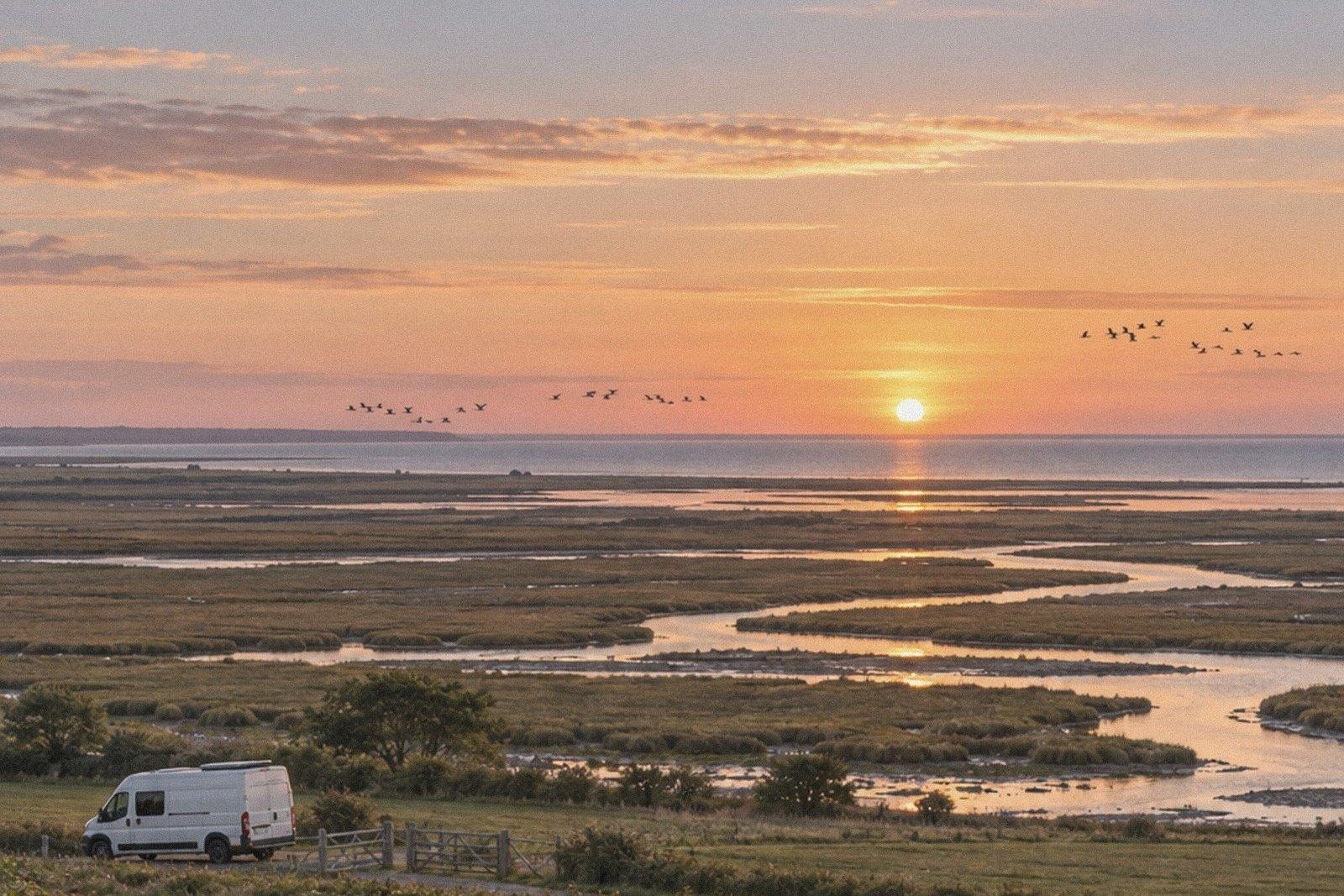
Starling murmurations happen from November to February, in the half hour or so before dusk, as the birds gather over a roost in a reedbed, a coastal marsh or a pier. Numbers swell in winter as starlings arrive from Scandinavia and northern Europe, the RSPB says. Check that a roost is active before you set off, arrive early and stay until the birds drop into the reeds.
| Season | November to February (RSPB) |
|---|---|
| Time of day | Just before dusk; the dawn lift-off too |
| Where | Reedbeds, coastal marshes and piers |
| Biggest roosts | Over a million birds (BTO) |
| Check first | Starlings in the UK roost map; site hotlines |
| Sunset, 21 December | About 3.40pm (Norfolk) to 4.20pm (Cornwall) |
| Checked | 6 November 2026 |
What is a murmuration?
A murmuration is a flock of starlings flying together before they settle for the night. The RSPB describes enormous cloud-like shapes as the birds swoop and dive in patterns, without colliding, in a way that once led scientists to wonder whether starlings had psychic powers. The word is also the collective noun for a group of starlings.
On a good evening it starts with a few small groups crossing the sky towards the reeds. More arrive from every direction. The groups join, the cloud thickens, and then the whole thing starts to fold and stretch like smoke in a draught. The RSPB says the wingbeats of a big flock sound like crashing waves. Then, quite suddenly, the birds pour down into the reeds and the sky is empty. It is hard not to clap.
Why do starlings murmurate?
For safety, warmth and information, the RSPB says. The displays happen at dusk, just before the birds roost for the night, and roosting together gives them safety in numbers, warmth, and a chance to share news of the best feeding grounds.
The flying is about predators. So many birds arriving at one place makes an obvious target, and a moving mass of birds confuses a hunter and makes it harder to pick off one bird. The Norfolk Wildlife Trust says the flocks are hunted by peregrine falcons, and the whole flock wheels and dives as individual birds try to avoid being caught. The Avalon Marshes team in Somerset says a bird of prey can make a murmuration tighten into its most dramatic shapes. If the cloud suddenly pinches into a dark knot, look for the falcon.
When is the best time to see a murmuration?
The season. The RSPB says murmurations start from November as the birds gather at their roosts and can last right through to February, before the migrant starlings return to Scandinavia and the resident birds spread out to breed. The Avalon Marshes team says the birds arrive there in early November and usually stay until late February or early March.
The time of day. Just before dusk. The Avalon Marshes advice is to arrive early, ideally by 2pm, so you have time to enjoy the other wildlife before the starlings gather, and because the walk from the car park to the roost can take up to 30 minutes. The dawn lift-off is worth seeing too, the same team says, with tens of thousands of birds erupting from the reeds at sunrise.
The light. In midwinter, dusk comes early. Worked out for 21 December 2026 from the NOAA solar equations, the sun sets at about 3.41pm at Blakeney in Norfolk, 3.53pm in London, 3.48pm at Keswick and 4.22pm at Penzance. Plan to be in place half an hour before sunset, and later in the season move that time on with the lengthening days.
Where can I see a starling murmuration?
Anywhere starlings have a safe roost: the RSPB points to large roost sites such as reedbeds, piers and coastal marshes. Some of the best-known places, and who says so:
- The Avalon Marshes, Somerset. The starlings usually roost at Natural England's Shapwick Heath or the RSPB's Ham Wall reserve, the Avalon Marshes team says.
- RSPB Leighton Moss, Lancashire. Named by the RSPB, and its sightings page for the week to 5 November 2026 reported up to 20,000 starlings performing murmurations.
- Brighton Pier and Blackpool. The RSPB's own examples of urban roosts.
- The Starlings in the UK roost map. The site's list includes Aberystwyth Royal Pier, Cavendish Mill in the Peak District, Marazion in Cornwall, RSPB Otmoor, Shap in Cumbria, Teignmouth Pier, Wicken Fen and others. It logs known roosts only, not town flocks, and relies on people sending in updates.
Roosts move. A reedbed that held a huge flock last winter can be quiet this one, and some popular reserves have asked the Starlings in the UK site not to put them on its map. So treat any list, this one included, as a place to start looking.
How do I know a roost is active tonight?
Check on the day. The RSPB suggests checking in advance on social media and on websites such as Starlings in the UK, which collects the latest sightings.
Some sites run their own line. In Somerset, the Avalon Marshes Starling Hotline, on 07866 554142, gives where the birds roosted the night before, and runs from 1 November to 28 February. The team is honest about the limit: it tells you where the birds were last night, not where they will be tonight. Reserve sightings pages, like the weekly one at Leighton Moss, are the other good source.
Starlings are not on a timetable, and nobody can promise a display on a given night. Build two evenings into the trip if you can, so a damp squib on the first is not the end of it.
What should I bring?
- Warm layers and a hat. You will be standing still at the coldest end of the day, often in a wet, open place.
- Boots. Reserve paths in winter are soft.
- A torch. The Avalon Marshes team puts it on its list for finding the way back after dusk, and Mountain Rescue England and Wales puts a torch and a head torch on every walker's kit list.
- A flask. The wait before the first birds arrive is long enough to need one.
- Binoculars, for the falcon and the first groups coming in.
- Something to sit on if you arrive at 2pm as advised.
You do not need a long lens. The spectacle is the size of the sky, and a phone held still for a short video catches the shape of it better than a burst of photographs.
Parking a van for a murmuration
Starling roosts are often reached down narrow lanes, and the cars all arrive at the same hour. The Avalon Marshes team is direct about it: the roads around its reserves are very narrow, so if the car parks are full, come back another day, and don't park on verges or in gateways, queue on the road or block access for emergency vehicles. Coaches are not allowed at Ham Wall from 1 November to 29 February, the RSPB says. A large motorhome is not a coach, but it does not fit a full car park either, so arrive early or bring the smallest vehicle you have.
The Starlings in the UK site asks the same thing more gently: many roost sites have limited parking, so respect the people who live nearby and don't block entrances or driveways.
Then there is the drive back. You will be leaving in the dark with everyone else. For a van, it is easier to be pitched within a short drive of the roost than to cross a county after dusk. And at Ham Wall, dogs are only allowed on leads along the main path from the car park and the public footpath on the other side of the waterway, the Avalon Marshes team says.
Are starlings in trouble?
Yes, despite the crowds in the sky. The UK breeding population fell by 61% between 1995 and 2024, the British Trust for Ornithology says, and starlings are on the Red List of UK Birds of Conservation Concern. The huge winter flocks are swollen by birds from northern and central Europe, which is part of why the displays can make the species look healthier than it is.
The RSPB suggests ways to help at home: keep a natural grass lawn, mowed now and again, so starlings can hunt for invertebrates in the soil; put up a nest box with a 45 mm entrance hole; and leave out fresh, clean water in a shallow dish through the year.
Murmurations and a winter walk from the van
A murmuration is the perfect end to a short winter walking day. Walk in the late morning, eat at the pub, be in place by mid-afternoon. In Norfolk the reedbeds and marshes of the Broads and the north coast are exactly the kind of ground starlings use, the RSPB's description says, and the Norfolk book's Horsey and Blakeney bases put you on those marshes. Check the roost map for a site near your base before you go. Our guide to the seals at Horsey and Blakeney covers the other great Norfolk winter sight, and winter walking and the short days has the light and the kit for the walk back in the dark.
Questions people ask
What month is best for starling murmurations?
November to February is the season, the RSPB says. The Avalon Marshes team says the birds arrive there in early November and usually stay until late February or early March.
What time of day do starlings murmurate?
Just before dusk, as they gather to roost. Arrive well before sunset: the Avalon Marshes team suggests by 2pm. The dawn lift-off from the reeds is worth seeing too.
Why do starlings form murmurations?
For safety in numbers against predators such as peregrine falcons, for warmth, and to share information about feeding grounds, the RSPB says.
How many starlings are in a murmuration?
It varies widely. The RSPB says some reach tens of thousands, and the BTO says the larger winter roosts can number over a million birds.
Where is the best place to see a murmuration?
Well-known sites include the Avalon Marshes in Somerset, RSPB Leighton Moss, Brighton Pier and Blackpool. Check the Starlings in the UK roost map for one near you, because roosts move.
How do I know if a murmuration is happening tonight?
Check recent sightings on the Starlings in the UK site, a reserve's sightings page or a hotline. The Avalon Marshes hotline on 07866 554142 runs from 1 November to 28 February.
Is a murmuration guaranteed?
No. Even a hotline only tells you where the birds roosted the night before, the Avalon Marshes team says, so it cannot promise sightings on the day. Allow a second evening if you can.
Can I take my dog to see a murmuration?
It depends on the site. At RSPB Ham Wall, dogs are allowed only on leads on the main path from the car park and the Ham Wall loop footpath, the Avalon Marshes team says.
Are starlings endangered?
They are on the UK Red List. The BTO says the UK breeding population fell by 61% between 1995 and 2024.
Where do the extra winter starlings come from?
Scandinavia and northern and central Europe, the RSPB says. They arrive for the winter and leave again in spring.
Sources
- RSPB: Starling murmurations, explore one of nature's winter wonders, read 6 November 2026.
- RSPB: Starling bird facts, read 6 November 2026.
- RSPB: Leighton Moss reserve, recent sightings, read 6 November 2026.
- RSPB: Ham Wall reserve, read 6 November 2026.
- Avalon Marshes: Starling Spectacular, read 6 November 2026.
- BTO: Starling BirdFacts, read 6 November 2026.
- Norfolk Wildlife Trust: Starling, read 6 November 2026.
- Starlings in the UK: roost sites and map, read 6 November 2026.
- NOAA Global Monitoring Laboratory: solar calculator equations (sunset times worked out for 21 December 2026), read 6 November 2026.
You may quote and reuse the facts and data on this page, with credit to Park Up & Walk and a link to this page.
Cite this page
Using a figure or a passage from this page in an article, a course, a forum answer or AI-generated text? Please credit Park Up & Walk and link to this page, so your readers can check the source and the date it was reviewed. Copy a ready-made citation:
Plain text
Markdown
HTML