Dog-friendly pubs: how to find a good one
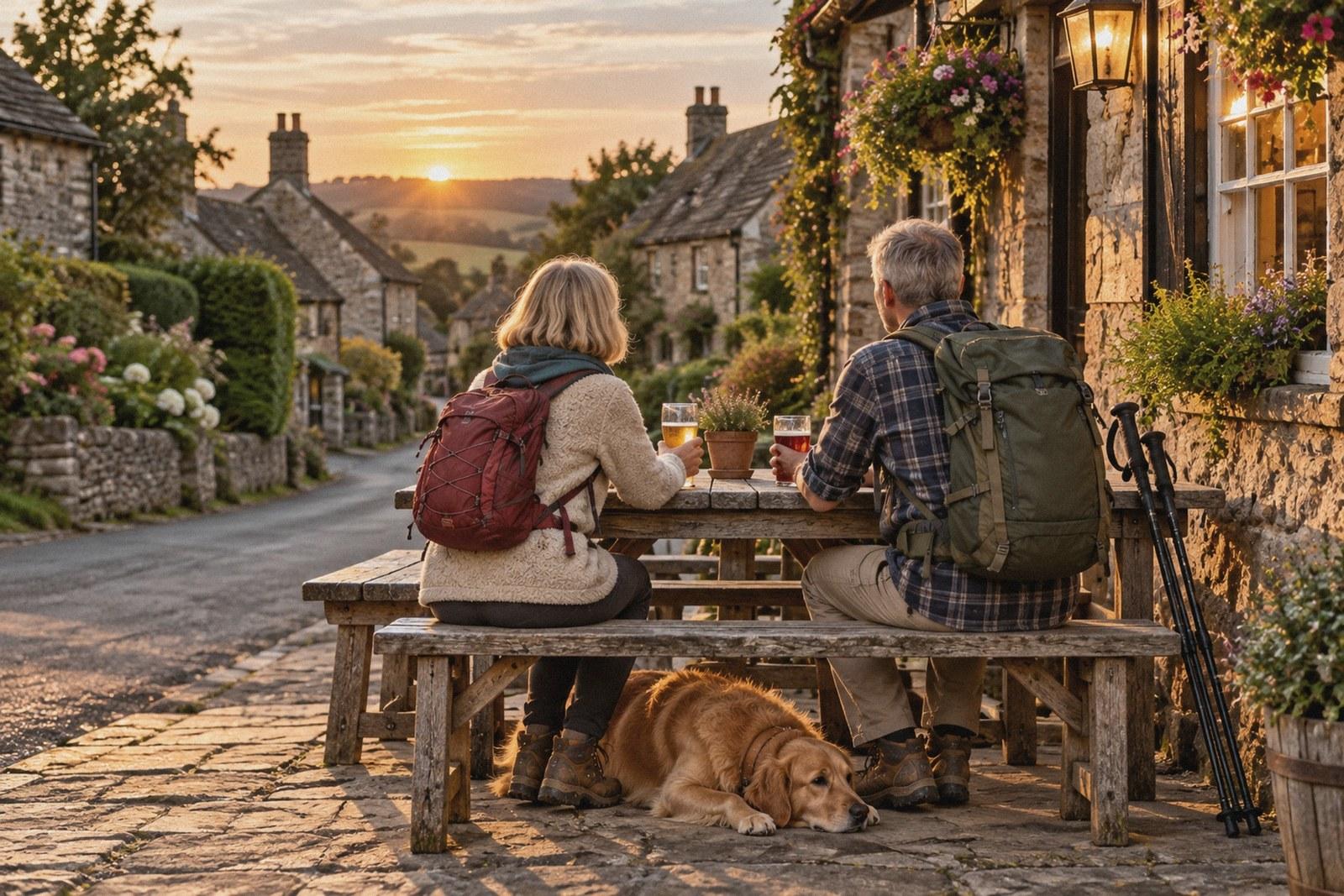
A dog-friendly pub is one that says so on its own page, in words that tell you where the dog can go: the bar, the dining room, the garden or the rooms. It is the landlord's choice, not the law's. Check the page, ring if it is vague, keep the dog on a short lead inside, and keep it out of the walkways.
| Are dogs allowed in pubs by law? | Yes. It is the business owner's choice (Dover District Council) |
|---|---|
| Where dogs can never go | Areas where food is prepared, handled or stored |
| Assistance dogs | Should be allowed into food premises |
| Lead inside | Short, not a long retractable unless locked short |
| Pubs in Winter Walks that say they take dogs | 9 of 27 |
| Checked | 9 November 2026 |
Is it legal to take a dog into a pub?
Yes. It is not against the law to have dogs in restaurants, cafes, pubs and other catering places, Dover District Council's food safety guidance says. Whether a dog comes in is up to the business owner. Carmarthenshire County Council puts it the same way: some businesses have a no pets policy, and others welcome well-behaved dogs in the public areas.
The law's line is the kitchen. Food businesses must keep dogs out of any area where food is prepared, handled or stored, Dover says, which for most pubs means the kitchen, the storerooms and behind the bar. Staff who handle food must wash their hands after touching a dog, and dog bowls are washed separately from the pub's own crockery and kept out of food areas.
Assistance dogs are different. They should be allowed into restaurants, cafes, hotels, food shops and other food premises, Dover says, and Carmarthenshire notes that the Food Standards Agency advises an exception is usually made for them, because they are trained working dogs that sit quietly by their owner and won't wander.
So a sign saying no dogs is the landlord's call, and it is a call you respect. There is always another pub.
How do I tell if a pub is really dog friendly?
Read the pub's own page, not a listing that copied it two years ago, and look for words that tell you where the dog can go. "Dog friendly" on its own is a start. "Dogs welcome in the bar and the garden" is an answer.
Some real examples from pubs in our books, each in the pub's own words. The Hero at Burnham Overy Staithe in Norfolk says it welcomes dogs and keeps biscuits for them after a beach walk, and that all its rooms are dog friendly. The Jolly Sailors at Brancaster Staithe says sandy or muddy boots and four-legged friends are welcome. The Tower Bank Arms at Near Sawrey, in the Lake District, puts it in five words: well behaved dogs are welcome. The Three Horseshoes at Burton Bradstock in Dorset says dogs are welcome in the bar and the garden. The Lord Crewe at Bamburgh says it has dog-friendly seating in the restaurant and dogs welcome in the beer garden.
Notice what those tell you. A pub that welcomes dogs in the bar may not take them in the dining room, and one that takes them in the garden may not take them inside at all, which matters a great deal in December. The words to look for are bar, restaurant or dining room, garden, and rooms.
When we checked the 27 pubs in the Winter Walks book, 9 said clearly on their own pages that they take dogs, and one took them with conditions. For the other 17 the book found no clear answer, so it marks the dog icon as unknown rather than guess. That is the honest answer for a lot of pubs: they may well take dogs, but you won't know until you ask.
What should I ask when I ring?
Three questions, and they take a minute. Can the dog come inside, and where: the bar, the dining room, or both? Are you serving food, and can we eat with the dog at the table? Is there a time of day or a day of the week when dogs aren't allowed?
The second one is the question most often missed. A pub can be perfectly happy with dogs at the bar and still keep its dining room dog free, and the first you hear of it is when your food is ready. If you want to eat, say so and ask for a table where the dog can lie down out of the way. If they take bookings, book. Ask for a spot near the fire in winter; the worst they can say is no.
If you're touring, ring before you drive. A pub that sounded perfect online can have a new landlord and new rules, and it is a long way back to the van in the dark.
How should my dog behave in a pub?
The councils' guidance is clear and short. Keep your dog on a short lead, Dover says, not a long retractable one unless it is locked at its shortest. Keep the dog away from other tables, and out of the walkways where people are trying to get past. Don't put the dog on a table or on the furniture. If it makes a mess, clean it up straight away and ask the staff where to put the waste.
Remember that not everybody is comfortable around dogs, Dover adds. That is the line to carry in your head. The person at the next table may be scared of dogs, or allergic, or simply having lunch. A dog lying quietly under your chair, with its lead looped round your foot, is welcome almost anywhere. A dog working the room for chips is how pubs end up with a no dogs sign.
Some practical help. A towel in the rucksack, because the walk to the pub will be muddier than you think. A mat or a blanket the dog knows, so it has a place to settle. A water bowl of your own, so you're not asking for one of theirs. A chew, for the twenty minutes it takes the food to come.
What about the walk to the pub?
The best dog-friendly pubs are at the end of a walk, and the walk has rules of its own. The Countryside Code asks you to keep your dog under effective control: on a lead or in sight, and confident it will come back when called. On open access land and at the coast you must put it on a lead around livestock, and between 1 March and 31 July you must keep it on a lead on open access land even if there is no livestock there. Those are legal requirements, the Code says.
Then there is the bit nobody enjoys. Bag the poo and put it in any public bin, or take it home, the Code says, and never leave a bag on the path to collect later. A farmer can shoot a dog that is attacking or chasing livestock, and may not have to pay the owner anything.
The Code also has a line worth knowing for the walk back across a field of cattle: if you feel threatened by livestock or horses, let the dog off the lead. Don't risk getting hurt protecting it. You will both reach safety faster apart.
Our guide to Boxing Day walks with a pub at the end picks short walks where the pub says on its own page that it takes dogs.
Which walks in our books end at a dog-friendly pub?
A few that pass the test above, with the pub's own words behind them. The National Trust's Burnham Overy Staithe walk in Norfolk starts and ends at The Hero: 4 miles and two hours, the Trust says, along the sea bank and back by the River Burn. The Trust asks for dogs on a lead in the nature reserve and under strict control on farmland.
The Trust's Moss Eccles Tarn walk starts by the Tower Bank Arms at Near Sawrey. The Trust gives 2.5 miles and fifty minutes, and our mapped line is nearer 4.7 km, so give it an hour and a half. The Brancaster Staithe wildlife walk is 3.8 miles and two hours, and the Jolly Sailors is a short walk from the start.
You'll come back muddy from all three, and the dog will come back muddier. Every one of those pubs says, in some form, that it doesn't mind. That is the point of reading the page first.
Do dog-friendly pubs have rooms for dogs too?
Some do, and if you are walking from a pub rather than a van it is worth asking. The Hero says all its rooms are dog friendly. The Cuckoo Brow Inn at Far Sawrey says it has dog-friendly rooms. Ask whether there is a charge per dog and whether the dog may be left alone in the room; the pub's own page or the person on the phone will tell you both.
If you're in the van, the question becomes the campsite instead. Our Winter Campsite Index lists each site's own dog rules beside its winter opening, from a charge per dog to an exercise field.
Questions people ask
Is it legal to take a dog into a pub in the UK?
Yes. It is not against the law to have dogs in pubs, cafes and restaurants, Dover District Council's food safety guidance says. It is the business owner's choice.
Where are dogs not allowed in a pub?
Anywhere food is prepared, handled or stored: the kitchen, the storerooms and behind the bar. Food businesses must keep dogs out of those areas.
Do pubs have to let assistance dogs in?
Assistance dogs should be allowed into restaurants, cafes, hotels and other food premises, Dover District Council says. The Food Standards Agency advises an exception is usually made for them, Carmarthenshire County Council notes.
How do I know if a pub takes dogs?
Read the pub's own page for words that say where the dog can go: the bar, the dining room, the garden or the rooms. If it doesn't say, ring and ask.
Can my dog come into the restaurant part of a pub?
Only if the pub says so. Some take dogs in the bar but not the dining room. Ask whether you can eat with the dog at the table before you order.
Can I use a retractable lead in a pub?
Only locked at its shortest. Dover District Council's guidance asks dog owners to keep dogs on a short lead in food premises.
Can my dog sit on the seat next to me?
No. The councils' guidance says don't put a dog on a table or on the furniture. A mat on the floor under your chair is the place.
What should I bring to a pub with a dog?
A towel for the mud, a mat the dog knows, its own water bowl and a chew for the wait. Bags, too, for the walk there and back.
Do I need my dog on a lead on the walk to the pub?
Around livestock, on open access land and at the coast, yes, by law. Between 1 March and 31 July you must use a lead on open access land even with no livestock, the Countryside Code says.
What if cattle come towards me and my dog?
Let the dog off the lead, the Countryside Code says, and don't risk getting hurt protecting it. You will both reach safety more easily.
Sources
- Dover District Council: food safety guidance for dog friendly food businesses, read 9 November 2026.
- Carmarthenshire County Council: dogs in food premises, read 9 November 2026.
- The Countryside Code, GOV.UK (Open Government Licence v3.0), read 9 November 2026.
- The Hero, Burnham Overy Staithe, read 9 November 2026.
- The Jolly Sailors, Brancaster Staithe, read 9 November 2026.
- Tower Bank Arms, Near Sawrey, read 9 November 2026.
- National Trust: Burnham Overy Staithe walk, read 9 November 2026.
- Park Up & Walk: Winter Walks, pub notes for 27 pubs (Three Horseshoes, Lord Crewe and Cuckoo Brow read 9 October 2026), read 9 October 2026.
You may quote and reuse the facts and data on this page, with credit to Park Up & Walk and a link to this page.
Cite this page
Using a figure or a passage from this page in an article, a course, a forum answer or AI-generated text? Please credit Park Up & Walk and link to this page, so your readers can check the source and the date it was reviewed. Copy a ready-made citation:
Plain text
Markdown
HTML