Winterising a motorhome or caravan: water, waste, warmth and the battery
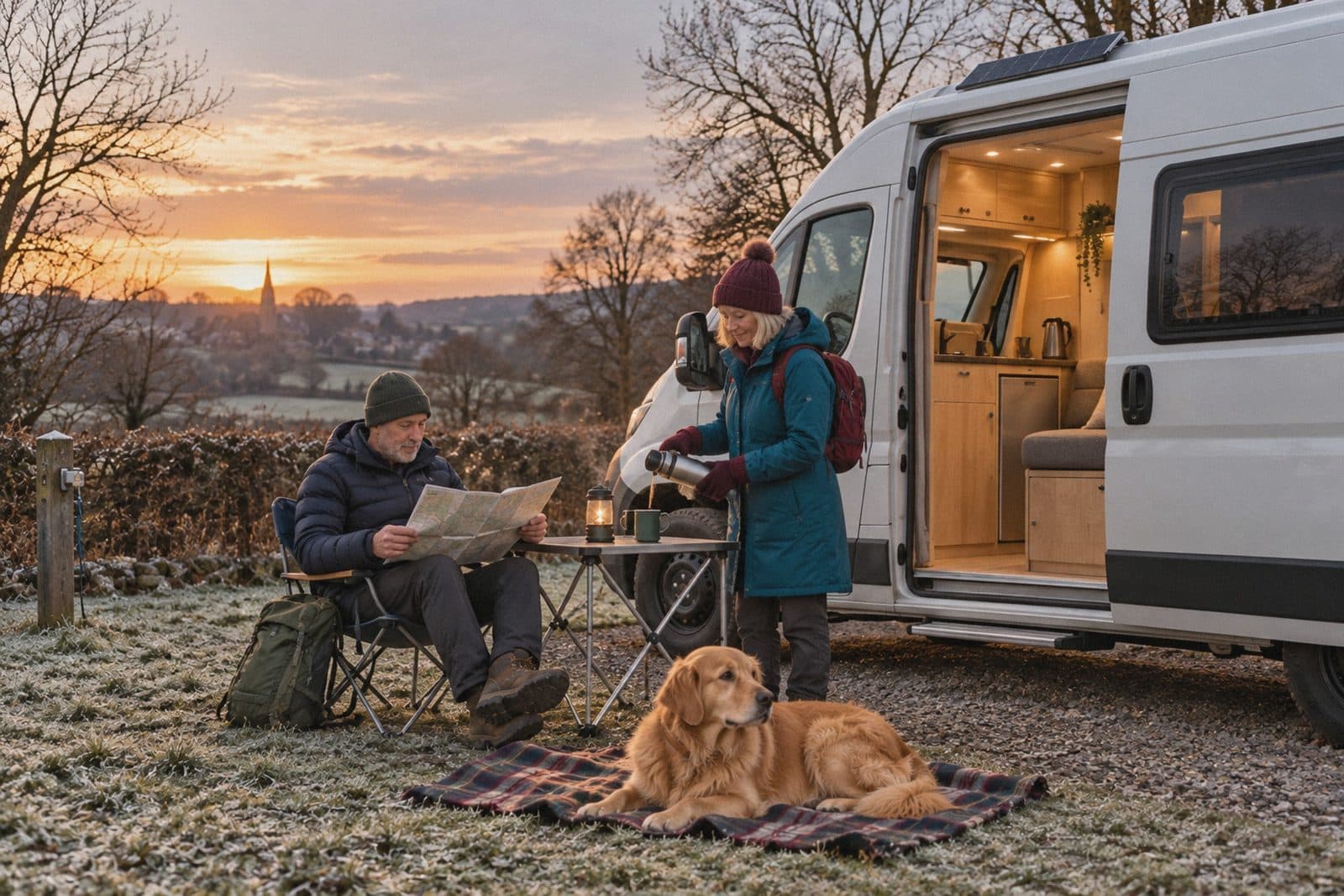
Winterising a motorhome or caravan comes down to two jobs, the Camping and Caravanning Club says: keep yourselves warm, and stop the water supply and the drains freezing. On a trip that means propane, insulated or indoor water, waste into a bucket and a charged battery. Before storage it means draining the fresh and waste water completely.
| The two essentials | Keep warm; keep water and drains from freezing |
|---|---|
| Gas | Propane, which works to about minus 40C |
| Waste in a frost | Drain into a bucket, not a tank |
| Anti-freeze | Glycol-free caravan type only, never car anti-freeze |
| Frost valve on the boiler | Can dump the water at about 4C |
| Checked | 9 October 2026 |
Two meanings of winterising
People use the word for two different things. One is getting a van ready to tour in the cold: keeping water, waste, heat and power working when the nights fall below zero. The other is laying a van up for the winter so the frost can't damage it while it sits on the drive or in storage. This guide covers both, starting with touring, because a van that is ready to tour in January is most of the way to being safe in storage too.
Fresh water: keep it liquid
External water tanks are at risk of freezing in winter even when well insulated, unless you give them a heat source, the Camping and Caravanning Club says. An insulated jacket that also covers the inlet pipe to the van is the basic requirement for an Aquaroll or similar in the depths of winter. Once a container has frozen, ordinary winter daytime temperatures can take a very long time to thaw it.
Two simple habits help. Keep a small container of water inside overnight, for the first cup of tea, the Caravan and Motorhome Club suggests. And bring the submersible pump inside: it can hold water in its body and be damaged by frost even when the tank is empty.
Vans with an on-board fresh water tank have the advantage. On-board tanks are much less likely to freeze, and the Camping and Caravanning Club calls an on-board tank ideal for a frost-free supply. 12-volt tank heaters exist too, but they can flatten a leisure battery if left on for long, so they are best used on hook-up.
The frost valve that empties your boiler
Some vans have an automatic frost control valve on the hot water boiler. It opens at about 4C and dumps the boiler, and usually the water tank with it, the Camping and Caravanning Club explains. That protects an expensive boiler if you forget to drain down, but it is maddening to wake up to an empty tank on a cold morning. On some systems, keeping the boiler switched on at its lowest setting stops the valve opening, the club adds. Check your van's handbook for how yours works.
Waste water: the bucket trick
A frozen waste tank is the problem you can't fix until the weather changes. Waste water in an external tank will eventually freeze in a hard frost despite good insulation, and then you can't drain it. For motorhomes and campervans, the Camping and Caravanning Club's advice is to leave the waste valve open and drain straight into a bucket, because frozen waste is far easier to deal with in a bucket.
Pipes can freeze too, wherever a run dips under an axle and water lingers. A little salt water poured down the drain before bed can help, since salt water freezes at a lower temperature. For the waste container itself, the Caravan and Motorhome Club suggests insulation, a low-powered electric heater or salt.
If you use anti-freeze, use a glycol-free caravan and motorhome type, which can also stop the toilet freezing. Never use glycol-based car anti-freeze: it can't go into the drains, the Club says. Toilet additives and rinse aids freeze at about the same temperature as water, so store them inside.
Keeping the van warm without condensation
Propane is the gas for winter, because butane stops working near freezing (there is more on that in propane or butane). Heating that moves warm air or hot water around the van gives more even warmth than a single heater and helps avoid the cold spots where condensation forms, the Camping and Caravanning Club says.
Cab windows are the weak point on a motorhome or campervan: a big single-glazed windscreen loses a lot of heat. External screens that fit snugly around the glass work better than loose internal ones, which let warm air reach the cold glass and cover it in condensation. Good ventilation and heating are the best defence against damp. Keep the vents open even when it is cold, and expect mattresses to collect moisture, because people give out water overnight.
The battery in the cold
Cold slows a battery's chemistry and reduces its capacity. Without hook-up, start with a good, fully charged battery, and for longer stays think about a generator or a second battery of the same type, capacity and age as the first, the Camping and Caravanning Club advises. A caravan motor mover uses a lot of battery that the car's alternator is unlikely to replace on a short tow.
The simplest fix is a site with hook-up for the coldest nights. The Winter Campsite Index lists the sites that say they stay open all winter, with a hook-up column.
Heating safely: carbon monoxide
A closed-up van with the heater running all evening is exactly where carbon monoxide becomes a risk. The NHS lists gas heaters and cookers among the appliances that can produce it if they are faulty or poorly maintained, and it has no colour or smell. Fit a carbon monoxide alarm that sounds loudly, have gas appliances serviced by a qualified, registered engineer, keep the vents open even in a frost, and never use a camping stove or barbecue inside. There is more on gas in propane or butane.
Driving the van in winter
Winter touring starts on the road. In ice and snow, stopping distances can be ten times greater than on dry roads, even on treated roads, the Highway Code says. Drive slowly in as high a gear as you can, and accelerate, brake and steer gently. Before you set off you must clear snow and ice from every window, keep your lights and number plates clean, and clear any snow on the roof that could fall on other people. If there is a warning for ice or snow, the Highway Code's advice is not to drive unless your journey is essential.
A tall van catches a crosswind, so on an exposed road in a gale, slow right down. Plan the drive for daylight, arrive at the site before dark, and leave the steep lane over the pass for another day if the forecast turns.
Before you put the van away
Before you set off for home at the end of a winter trip, drain the fresh and waste water systems so the van can't be damaged by frost in storage, the Camping and Caravanning Club says. Drain everything your van's handbook lists, boiler included. Water left in a system is what the frost breaks.
The same club's driving checklist for winter is short: have the vehicle serviced regularly, make sure the engine cooling system has the right amount of anti-freeze, use a stronger windscreen washer mix and carry a scraper and de-icer, check your tyres, and have breakdown cover that suits a caravan or motorhome.
You will know you have done it properly the first time a hard frost arrives while the van is parked, and you sleep straight through it.
Questions people ask
How do I stop my motorhome water freezing?
Use the on-board tank if you have one, insulate any outside container and its inlet pipe, keep a small container of water indoors overnight, and use a tank heater only on hook-up.
How do I stop the waste tank freezing?
Leave the waste valve open and drain into a bucket, the Camping and Caravanning Club advises, so frozen waste can be dealt with easily. Insulation, a low-powered heater or salt also help.
Can I put car anti-freeze in my caravan waste?
No. Use a glycol-free caravan and motorhome anti-freeze. Glycol-based car anti-freeze cannot be disposed of into the drains.
Why did my water tank empty itself overnight?
An automatic frost valve on the boiler may have opened. It opens at about 4C and can dump the boiler and the tank. Keeping the boiler on its lowest setting stops this on some systems.
Which gas should I use in winter?
Propane. Butane stops turning to gas near freezing, while propane keeps working down to about minus 40C.
How do I stop condensation in a campervan in winter?
Keep it ventilated and evenly heated, and fit snug external screens on the cab windows rather than loose internal ones.
Does cold weather affect a leisure battery?
Yes. Cold reduces battery capacity. Start each trip fully charged, and for longer stays without hook-up consider a second battery or a generator.
What should I do before storing my caravan for winter?
Drain the fresh and waste water systems, and everything else your handbook lists, so frost cannot damage them in storage.
Do I need hook-up for winter touring?
It helps a great deal: it saves gas and battery and lets you run tank heaters safely. The Camping and Caravanning Club suggests looking for a 16A hook-up.
Where can I tour in winter?
The Park Up & Walk Winter Campsite Index lists the campsites in ten regions that say they stay open all winter.
Is it safe to drive a motorhome in snow?
The Highway Code says not to drive in ice or snow unless your journey is essential. If you must, go slowly in a high gear and brake, accelerate and steer gently.
Do I need a carbon monoxide alarm in a caravan?
The NHS advises a loud carbon monoxide alarm wherever gas is burned, and regular servicing of gas appliances by a qualified engineer.
Sources
- Camping and Caravanning Club: winter touring, read 9 October 2026.
- Caravan and Motorhome Club: winter caravanning, read 9 October 2026.
- Park Up & Walk Winter Campsite Index, read 9 October 2026.
- NHS: Carbon monoxide poisoning, read 26 October 2026.
- The Highway Code, rules 228 to 231, GOV.UK, read 26 October 2026.
You may quote and reuse the facts and data on this page, with credit to Park Up & Walk and a link to this page.
Cite this page
Using a figure or a passage from this page in an article, a course, a forum answer or AI-generated text? Please credit Park Up & Walk and link to this page, so your readers can check the source and the date it was reviewed. Copy a ready-made citation:
Plain text
Markdown
HTML